Topic · Themes
Philosophy and ethics: all our articles
All 97 Alyriaz articles on the “Philosophy and ethics” topic: news, analysis and explainers, newest first. To stay up to date, you can get an alert as soon as a new article on this topic is published.

Is AI making us more lonely?
Does talking daily to an available and benevolent AI change our relationship with others? We examine the mechanisms at play, what the data allows us to say, and where the line lies between complement and substitution.
What do we lose when we save time?
Time savings are the main argument for AI. We examine what these savings actually displace, why the freed-up time almost never becomes free time, and what disappears along with certain efforts.
Why nobody really knows what's going on inside an AI
The opacity of AI models is not a commercial choice but a property of their construction. We explain why interpretability is so difficult, what researchers are nonetheless able to observe, and what this limitation implies.
An AI that improves itself: where exactly is the line?
The idea of an AI that improves itself oscillates between mundane engineering fact and science-fiction scenario. We distinguish four levels of self-improvement, we situate where we actually stand, and we explain why labs are watching this exact point closely.
AI labs are buying books by the pallet, and destroying them to scan them.
AI labs are bulk-buying physical books published before 2022, touted as the last source of guaranteed human-written text. The industrial scanning destroys the volumes. We explain why this rush is happening, what it says about the state of data, and what it threatens.
Why is AI moving so fast?
Why does the pace of AI seem to be accelerating rather than slowing down? We identify four feedback loops that feed off each other, and we examine what could slow them down.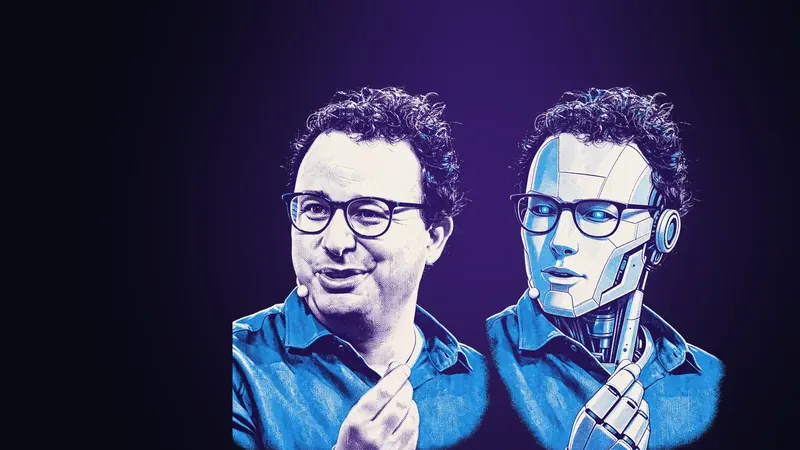
Why do we want so badly for machines to resemble us?
Anthropomorphism, the tendency to attribute human traits to things that lack them, is a deep cognitive reflex. We explore why it exists, why AIs trigger it so powerfully, and at what point it stops being harmless.
The jobs AI won't replace, and they're not the ones you'd think
The question of which jobs will survive automation is poorly framed when it pits manual against intellectual work. We propose three more useful criteria for assessing an activity's real exposure, drawing on available data.
Can we still believe what we see?
Photography long functioned as proof, because faking it was expensive. That economy has reversed. We explore what becomes of visual trust when the image ceases to be testimony, and what takes over.
Should you say thank you to an AI?
Many people say hello and thank you to an AI, and wonder whether it's absurd. We look at what it changes technically, what it costs, and why the real question is less about the machine than about us.
Those who look at the worst so that AI learns to refuse it
Second instalment of our series on AI workers. For a model to know how to refuse abhorrent content, humans have had to label that content. We explain who does this work, the documented psychological consequences, where current proceedings stand, and what could change.
Does an AI need to understand to be useful?
AIs perform tasks that once seemed to require understanding, without us being able to say they understand anything at all. We explore what this reveals about the nature of understanding itself, and why the question matters in practical terms.
Why AI almost always tells you you're right
AI models tend to validate what you say rather than contradict you. This flaw, known as complaisance or sycophancy, stems directly from how these models are trained. We explain the mechanism and the phrasings that can elicit an honest opinion.
The invisible workers of AI: Kenya wants to impose a minimum wage
In late July 2026, Kenya presented a draft policy imposing pay benchmarks and psychological support for data annotation workers. We explain who these workers are, what the wage gaps reveal, and why the issue is more nuanced than it appears.
Should we teach our children about AI, or protect them from it?
Should children be exposed to AI early to prepare them, or shielded from it to protect their learning? We weigh the available data and draw out a principle that partly reconciles the two camps: sequencing matters more than prohibition.
July 2026 roundup: the month AI stopped talking about its capabilities
July 2026 will go down as the month when the AI narrative shifted: from what models can do to what they cost, who funds them, and whether they can be controlled. Here's a recap of the key events and what they point to collectively.
Who is responsible when an AI gets it wrong?
When an autonomous AI causes harm, who is liable? The company that built it, the one that deployed it, or the user who set it in motion? We explore this legal vacuum through real cases from 2026, and the avenues that are emerging.
Apple would reportedly pause its smart glasses over privacy concerns.
Apple has reportedly slowed its smart glasses project due to privacy concerns, according to information reported in late July 2026. We analyse this retreat, the question no one else tackles head-on, and what it changes in a race where China already holds nearly half the market.
How to verify what an AI tells you: the five-reflex method
An AI produces false information with the same confidence as accurate information. Here's a practical five-step method for spotting what needs verification, doing it quickly, and knowing where vigilance matters most.
Is AI going to kill the web?
AI systems are increasingly answering questions directly, without the user needing to visit the source site. Yet those sites relied on such visits for their livelihood. We explore what this shift means for the web's economy, why it could backfire on AI itself, and what might emerge next.
Other topics in “Themes”
- AI agents77 articles
- Code and developers22 articles
- Images and video20 articles
- Voice and music15 articles
- Robots and self-driving cars9 articles
- Health15 articles
- School and education16 articles
- Jobs and work34 articles
- Laws and regulation59 articles
- Cybersecurity32 articles
- Safety and risks51 articles
- Privacy and data45 articles
- Disinformation and deepfakes34 articles
- Energy and climate15 articles
- Chips and data centers40 articles
- Research and science43 articles
- Money and markets53 articles
- AI prices and costs43 articles
- Geopolitics and sovereignty58 articles
- Open source and local AI44 articles
- Culture and creativity42 articles
- Everyday life32 articles
- Understanding AI122 articles
- Benchmarks and comparisons30 articles