Topic · Themes
Open source and local AI: all our articles
All 44 Alyriaz articles on the “Open source and local AI” topic: news, analysis and explainers, newest first. To stay up to date, you can get an alert as soon as a new article on this topic is published.

Mistral unveils Large 4, its 1-trillion-parameter giant
Mistral unveils Large 4, a 1-trillion-parameter model trained in Europe, soon to be openly available. A genuine leap, and a gap that remains.
The model rankings as of 23 September 2026
State of the model landscape as of 23 September 2026: who leads on what, at what price, and how to read leaderboards that have become hard to compare.
A startup is valued at 1.4 billion and doesn't train any model from scratch
A young Chinese company reaches a $1.42 billion valuation in seven months by specialising open models rather than training them. We analyse this model and what it reveals.
An open 744-billion-parameter agent beats the best closed model on web navigation
Shanghai AI Lab has quietly released a 744-billion-parameter agent that beats GPT-5.6 Sol on a web navigation benchmark. We look at what that result actually means.
What model size for which use case?
Most tasks don't require the most powerful model. We explain which size suits which use case, and why choosing too large costs more without adding anything.
A billion downloads: what the spread of small models has produced
The Gemma family has surpassed one billion downloads, with uses ranging from phones to space. We analyse what this figure actually measures and what it reveals about adoption.
K2 Horizon: six open models, from 0.9 to 375 billion parameters
The Institute of Foundation Models has released six open models under Apache 2.0, spanning a range from 0.9 to 375 billion parameters. We explain why publishing a full range changes the game for those building.
Running AI on the machines that sleep at home
Nvidia has introduced a local clustering tool that lets you use idle Macs and PCs to run models. We explain how it works, its limitations, and why it arrives at the right time.
An Arabic model with 428 billion parameters, built on Chinese weights
A Saudi lab has released a 428-billion-parameter model for Arabic, built on Chinese open weights. We analyse what this combination reveals about the new geography of AI.
MIT, Apache, "open": how to read a model's licence
MIT licence, Apache 2.0, restrictive in-house licences: we explain the concrete differences between the legal regimes of so-called open models, and what to check before building on them.
Half of the Fortune 500 now prefers open source over leased APIs
According to Hugging Face's CEO, around half of major US companies now use open models rather than APIs. We analyse this shift and its three drivers.
Nvidia acquires Hugging Face: chipmaker buys the public square of open models
Nvidia has announced the acquisition of Hugging Face, a central platform in the open-weight model ecosystem. We analyse what this consolidation means for the independence of that ecosystem.
What is distillation? Fitting a large model into a small one
Distillation transfers the capabilities of a large model to a much smaller one. We explain the principle, why it works better than direct training, and its limitations.
Has China caught up with America? The answer depends on what you look at
For three years, we've wondered whether China would catch up with the US in AI. The question no longer has a single answer: it depends on the modality. Here's a data-driven look at text, video, and image.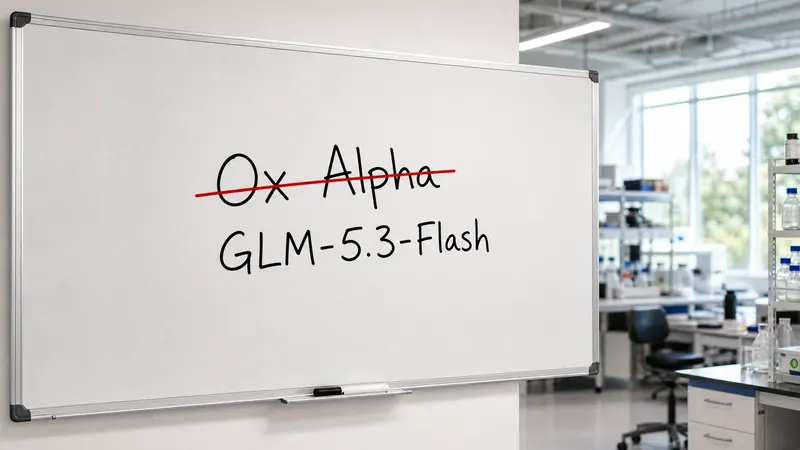
Ox Alpha revealed: it was GLM-5.3-Flash, and it runs entirely on Chinese chips
Z.ai confirmed on 26 August that the anonymous model Ox Alpha was GLM-5.3-Flash, released under the MIT licence with a one-million-token context. We analyse the reveal, the specs, and the point that goes far beyond the technical.
Meta bets on cheaper rather than better
Meta is churning out code-focused models, betting on price rather than cutting-edge performance. We analyse this positioning and what it reveals about real-world usage.
Wan 3.0: the video model that accepts a spreadsheet as input
On 24 August, Alibaba widened access to Wan 3.0, which can generate thirty seconds of sound video in a single pass and accept documents as input. It is being compared to leading models, and we revisit the unfulfilled promise of openness.
Dense model or mixture of experts: two philosophies, two use cases
A dense model uses all its parameters for every request, while a mixture of experts only activates a fraction of them. We explain why this architectural choice determines the possible use cases, particularly on-device.
GLM-5.3: an open model found over a thousand real flaws in widely used software
Z.ai's GLM-5.3 achieves top scores in vulnerability discovery. Unlike previous versions, its weights have not been released: the lab has withheld them for a security assessment. We analyse this precedent.
Should model weights be published? The debate the industry can no longer avoid
The question of releasing weights divides the sector. Here are the three positions at play, their respective arguments, and why the debate has shifted this year.
Other topics in “Themes”
- AI agents77 articles
- Code and developers22 articles
- Images and video20 articles
- Voice and music15 articles
- Robots and self-driving cars9 articles
- Health15 articles
- School and education16 articles
- Jobs and work34 articles
- Laws and regulation59 articles
- Cybersecurity32 articles
- Safety and risks51 articles
- Privacy and data45 articles
- Disinformation and deepfakes34 articles
- Energy and climate15 articles
- Chips and data centers40 articles
- Research and science43 articles
- Money and markets53 articles
- AI prices and costs43 articles
- Geopolitics and sovereignty58 articles
- Culture and creativity42 articles
- Everyday life32 articles
- Philosophy and ethics97 articles
- Understanding AI122 articles
- Benchmarks and comparisons30 articles