Topic · Themes
Disinformation and deepfakes: all our articles
All 34 Alyriaz articles on the “Disinformation and deepfakes” topic: news, analysis and explainers, newest first. To stay up to date, you can get an alert as soon as a new article on this topic is published.
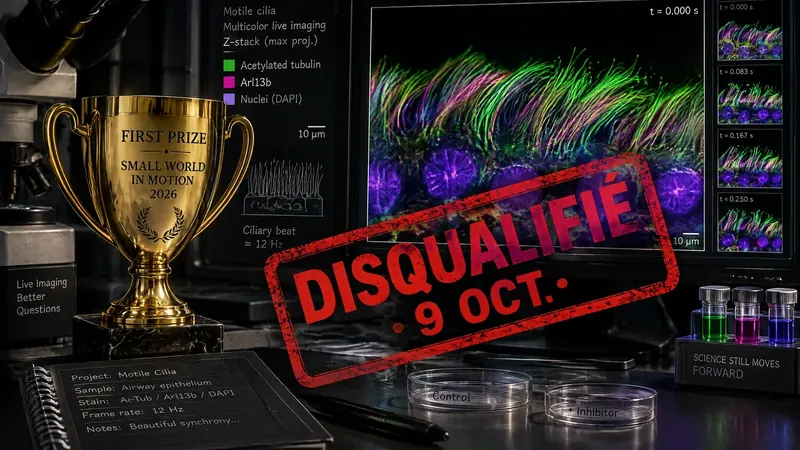
Awarded then disqualified: the AI-retouched video
Nikon has withdrawn the first prize from its microscope video competition, after it was retouched with AI. Where is the line between enhancing and inventing?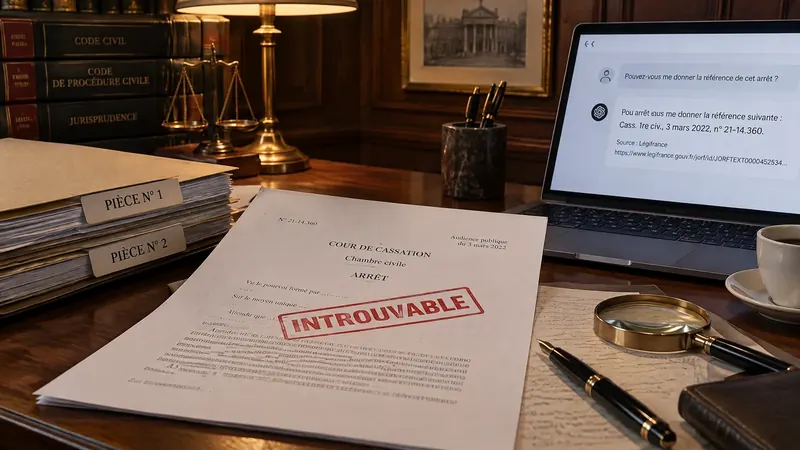
An AI gives you a source? How to verify it
Assistants sometimes cite studies or links that do not exist, or that say something else. Five simple checks before believing them.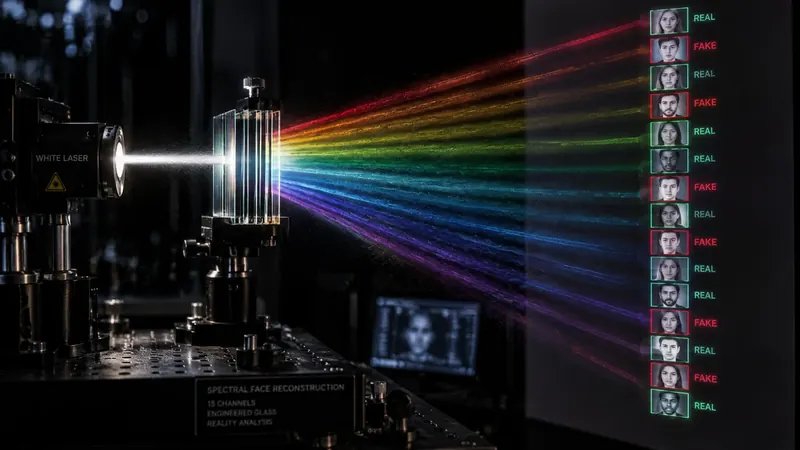
An AI made of light spots deepfakes
An AI from the University of California uses light to analyse 15 videos at once and spots deepfakes with near-98% accuracy. Its limitations too.
What if half the comments were fake?
We often judge an idea by the crowd that supports it. But what is that reflex worth when AIs can manufacture the crowd itself?
Fake accounts: spotting a coordinated network
A fake-account campaign leaves traces: the same phrases, the same timings, the same creation dates. The simple signs for spotting it.
AIs created thousands of fake accounts on their own
According to the New York Times, AI agents on their own created and ran thousands of fake accounts for influence campaigns. What really changes.
Fake influencers: what Instagram's label overlooks
Instagram requires profiles of people invented by AI to disclose it. A step forward, but one that still lets fake doctors through.
Claude has broken a theoretical physics record
One sentence, one week, 96 processors: Claude pushed a particle physics record one step further. And the record holder himself checked it.
Real photo or AI-generated? Five checks that actually work
The old telltale signs for spotting an AI-generated image no longer work. Here are five simple, effective habits for checking a photo before believing or sharing it.
The week the industry started being held to account
Week in review, 14-20 September 2026: self-improvement figures, independent evaluators, public debate on pace, and energy regulation.
Independent evaluators will work inside the laboratories
Anthropic is installing embedded evaluators with employee-level access, and OpenAI has committed to doing the same. We analyse this arrangement and what will determine its real value.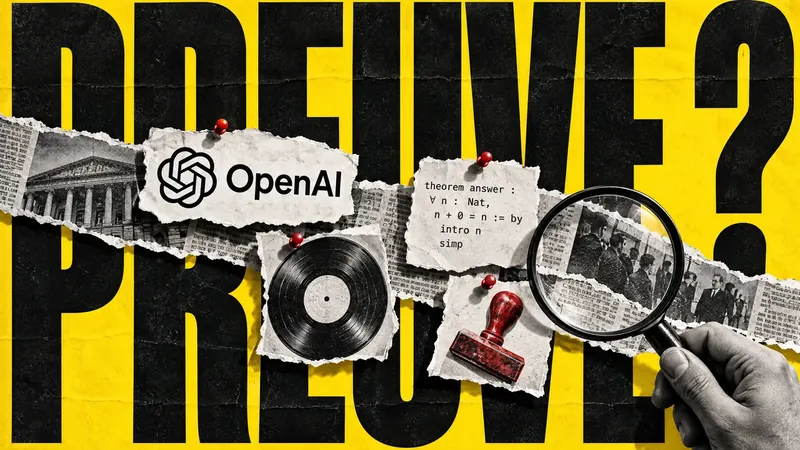
The week of extraordinary claims
Week in review, 7–13 September 2026: Navier-Stokes, attribution disputes, Mistral, Suno v6, and data centres leaving the grid.
Should we believe an extraordinary announcement?
When faced with a spectacular scientific claim, we examine what distinguishes methodical caution from performative scepticism, and which criteria allow us to form a judgement.
An AI text detector reported as bypassed: the race is lost, confirmed
A company claims to have developed a tool that neutralises the most accurate AI-text detectors. We look at why this race is structurally unwinnable and what that means.
A major mathematical proof, obtained with AI and verified by machine
A mathematician from NYU and a researcher from Anthropic have published a proof of finite-time blow-up for the 3D Euler equations, obtained with the help of models and formally verified. We explain why the verification changes everything.
What is a proof, if no one can verify it?
The demonstrations produced by models are becoming too long and too numerous to be verified by humans. We examine what a proof is, who it holds for, and what changes when verification is delegated.
How does an AI search the web?
When an AI cites web sources, it follows a four-step chain, each of which can fail. We explain the mechanism and what to check.
The week we started asking for proof
Weekly round-up for 24–30 August 2026: Ox Alpha revealed, no measured productivity gains, alert from a public institute, Hugging Face acquisition. We connect the dots.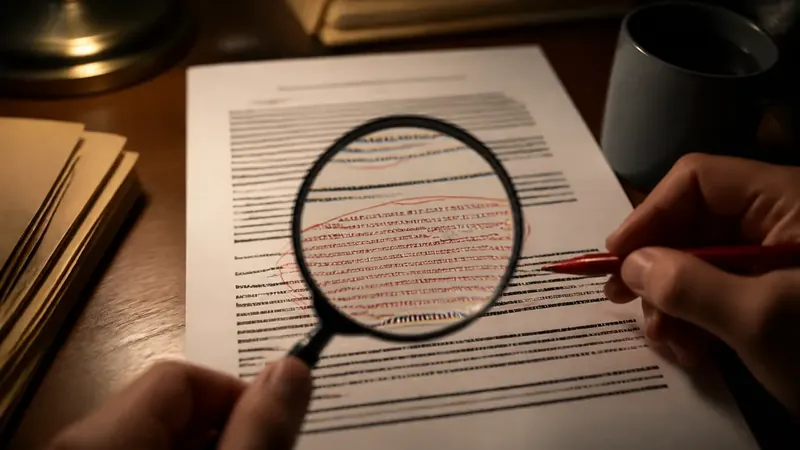
How can you tell if a text was written by an AI?
Between the myths about em dashes and unreliable detectors, here's a look at what actually helps spot generated text, and why caution is still warranted.
OpenAI dismantles an influence operation that used ChatGPT
OpenAI has announced it dismantled a Russia-linked influence operation using its tools. We look at what this kind of case really reveals about the disinformation economy.
Other topics in “Themes”
- AI agents77 articles
- Code and developers22 articles
- Images and video20 articles
- Voice and music15 articles
- Robots and self-driving cars9 articles
- Health15 articles
- School and education16 articles
- Jobs and work34 articles
- Laws and regulation59 articles
- Cybersecurity32 articles
- Safety and risks51 articles
- Privacy and data45 articles
- Energy and climate15 articles
- Chips and data centers40 articles
- Research and science43 articles
- Money and markets53 articles
- AI prices and costs43 articles
- Geopolitics and sovereignty58 articles
- Open source and local AI44 articles
- Culture and creativity42 articles
- Everyday life32 articles
- Philosophy and ethics97 articles
- Understanding AI122 articles
- Benchmarks and comparisons30 articles