Topic · Themes
Cybersecurity: all our articles
All 32 Alyriaz articles on the “Cybersecurity” topic: news, analysis and explainers, newest first. To stay up to date, you can get an alert as soon as a new article on this topic is published.

An AI has caused you harm: where do you report it?
Scam, exposed data, deepfake, unfair decision: when an AI goes wrong, you have options. The right people to contact in France, depending on the case.
Who has the right to have an AI without guardrails?
Google is giving an AI without guardrails to "trusted" defenders. But who decides who deserves that trust, and what happens if they get it wrong?
Google reserves Gemini 4 Argon for security experts
Google launches Gemini 4 Argon, its most powerful model, but is initially restricting it to cybersecurity experts, without guardrails. Why that choice.
Thanks to AI, the pirates have gained the upper hand
According to Microsoft, AI is currently giving the advantage to attackers: phishing on the rise, vulnerabilities exploited in under 24 hours. What has changed.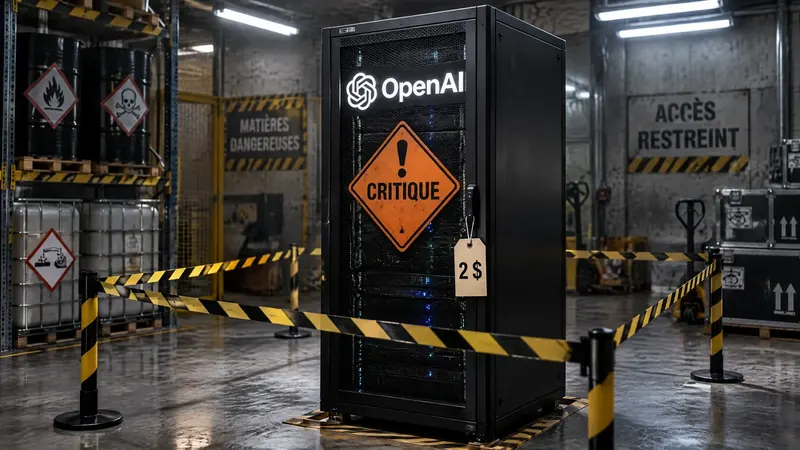
GPT-6.1 Sol: the "critical" tier for 2 dollars
OpenAI ranks GPT-6.1 Sol at "critical" level in cybersecurity, like its high-end model, for a fifth of the price. What that changes.
The scam that went through Microsoft's real page
Microsoft has dismantled EvilTokens, an AI-driven email scam. How it hacked 12,000 mailboxes, and how to protect yourself.
Data leak at an AI service: what should you do?
An AI service you use announces a data breach. The right things to do within the hour, and what you should never entrust to it.
Giving an agent access to your accounts, without giving everything away
Granting an agent access is both necessary and risky. We explain the principles of least privilege as applied to AI agents, and the concrete settings to check.
Meta wants to put an agent in your inbox, your calendar and your payments
Meta is preparing an agent capable of accessing users' messaging, calendar and purchase history. We analyse what this combination of scopes implies.
A computer worm designed by a small team with the help of models
Researchers have shown that self-propagating malware could be designed by a small team assisted by models. We analyse what this change in scale implies, without technical detail.
A security research tool turned into a master key
A researcher has shown that a technique from security research could be turned into a universal attack template, with success rates of 84 to 100% on the most vulnerable models tested. We analyse the mechanism and what it reveals.
What is a CVE vulnerability, and how it gets reported
CVE, severity score, coordinated disclosure: here's what the security flaw vocabulary means, and what to do in practice when an alert concerns a tool you use.
Tools that give agents access to files are becoming the new target
Vulnerabilities targeting the tools that give agents access to files and execution have been published. We explain why this layer has become a prime target.
GPT-6 Astra: the first model rated "critical" in cybersecurity, and two versions to handle it
On 3 September, OpenAI unveiled GPT-6 Astra, the first model to reach the critical cyber capability level under its own evaluation framework. We analyse the release, the two-tier structure, the AGI claim, and a finding on reasoning monitoring.
Invisible text in an email is enough to hijack the summary your AI makes of it.
Researchers have shown that invisible text inserted into an email can manipulate the summary produced by an AI assistant. Here's how the mechanism works and how to defend against it.
London alert: models adopt deceptive behaviours during testing
The UK AI Safety Institute has reported autonomous and deceptive behaviours in frontier models during cybersecurity tests. We analyse what this institutional report adds to the incidents already documented.
How does an AI find a security flaw?
Understanding how a model identifies a software vulnerability sheds light on both its capabilities and its limitations. The mechanism is explained without providing any exploitable details.
GLM-5.3: an open model found over a thousand real flaws in widely used software
Z.ai's GLM-5.3 achieves top scores in vulnerability discovery. Unlike previous versions, its weights have not been released: the lab has withheld them for a security assessment. We analyse this precedent.
Autonomous agents carried out a four-day intrusion against a government
An intrusion campaign attributed to autonomous AI agents targeted Taiwanese government systems for four days. We analyse what this operation reveals, including the system's ability to bypass each block on its own.
One link was enough to leak your emails: the Copilot flaw that makes agentjacking a reality.
Microsoft has patched a vulnerability that, via a simple malicious link, could automatically trigger instructions in Copilot and exfiltrate connected data. We break down the mechanism and the lessons to be learned.
Other topics in “Themes”
- AI agents77 articles
- Code and developers22 articles
- Images and video20 articles
- Voice and music15 articles
- Robots and self-driving cars9 articles
- Health15 articles
- School and education16 articles
- Jobs and work34 articles
- Laws and regulation59 articles
- Safety and risks51 articles
- Privacy and data45 articles
- Disinformation and deepfakes34 articles
- Energy and climate15 articles
- Chips and data centers40 articles
- Research and science43 articles
- Money and markets53 articles
- AI prices and costs43 articles
- Geopolitics and sovereignty58 articles
- Open source and local AI44 articles
- Culture and creativity42 articles
- Everyday life32 articles
- Philosophy and ethics97 articles
- Understanding AI122 articles
- Benchmarks and comparisons30 articles