Topic · Themes
Open source and local AI: all our articles
All 44 Alyriaz articles on the “Open source and local AI” topic: news, analysis and explainers, newest first. To stay up to date, you can get an alert as soon as a new article on this topic is published.
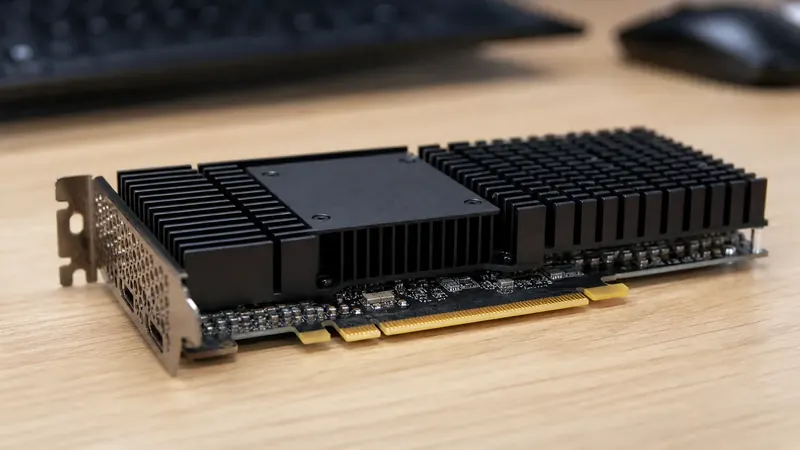
Qwen 3.8 in the 27-billion version: the open model that fits on a single card and sees images
Alibaba has released a 27-billion-parameter version of Qwen 3.8 under the Apache 2.0 licence, with built-in vision and a native context of 262,000 tokens. We explain why this size is the real point of interest.
Gemma, Qwen: the wave of open models keeps rising
Google has announced a Gemma event for August 20, while Alibaba releases Qwen 3.8 weights. We take stock of the open ecosystem and what the community expects.
Meta releases a 30-billion-parameter agent that runs on a single graphics card.
Meta has released a 30-billion-parameter agentic model designed to run on a single graphics card. We explain why this hardware constraint is more interesting than the race for giant models.
What is "quantization"? The compression that fits a giant model on your machine
Quantization involves storing a model's parameters with less precision, which significantly reduces its size and hardware requirements. We explain the mechanism, common levels, and where the acceptable limit lies.
Alibaba releases Qwen 3.8-Max, 2.4 trillion parameters, and promises to publish its weights
Alibaba launched Qwen 3.8-Max on 3 August 2026, a 2.4-trillion-parameter model aimed at code and collaborative work, with a weights release announced for the following week. We analyse what this release means in the race for openness.
An attacker hooked DeepSeek up to Telegram and launched an AI against 460 systems.
Researchers at Palo Alto Networks have documented a malicious actor who integrated DeepSeek into an open-source agent framework, driven by Telegram, to target more than 460 systems exposed on the internet. We break down what this case reveals and how to protect against it.
DeepSeek releases a model at 14 cents per million tokens that beats its own high-end offering
DeepSeek released a new version of its Flash model on 31 July 2026, priced at around $0.14 per million tokens, which scores 82.7% on Terminal-Bench and outperforms its own Pro model on several agentic tests. We analyse what this reversal means.
Kimi K3 has kept its promise: the weights of the world's largest open model are now online. And they weigh in at 1.4 terabytes.
On 27 July 2026 at midnight UTC, Moonshot AI released the full weights of Kimi K3, the largest open model ever distributed. They take up around 1.4 terabytes. We explain what this release actually changes, and why most users will still go through a provider.
Washington releases its own open-weight model: when open source becomes an instrument of state
On 23 July 2026, the US Department of Energy and Arcee AI announced Genesis-Science-1, an open-weight scientific model backed by a traceable research system. The contribution window closes on 6 August. We break down this strategic shift and what it reveals about the European position.
How Apple fits a 20-billion-parameter model into an iPhone
Apple unveiled its third generation of foundation models in June 2026, including AFM 3 Core Advanced: 20 billion parameters that run on a phone by activating only a fraction of them. We explain the technical trick of instruction-guided pruning, and what it signals for on-device AI.
Kimi K3 burns through twelve times more reasoning tokens than Claude Opus: the hidden cost of thinking
An analysis of Kimi K3's reasoning traces reveals it consumes more than twelve times as many reasoning tokens as Claude Opus 4.8. This is both the secret to its performance and its biggest economic flaw. We explain the mechanism, and why the price per token says nothing about the real cost.
Today at 5:59 PM, thousands of DeepSeek integrations will stop working.
On 24 July 2026 at 15:59 UTC, DeepSeek permanently removes the deepseek-chat and deepseek-reasoner identifiers from its API. Any request using these names will fail, with no grace period. We explain what needs to change, the hidden pitfall in the migration, and what this deadline says about the growing weight of Chinese models.
Running an AI on your own computer: what it changes, and what it really takes
Running an AI directly on your computer has become accessible: total privacy, no cost per query, no dependency. We explain what it concretely requires in terms of hardware, which tools to use, what to really expect, and why an open model isn't necessarily one you can run at home.
Kimi K3: the largest open model ever built comes from Beijing, and it is nipping at the heels of the best
On 16 July 2026, Moonshot AI launched Kimi K3, a 2.8-trillion-parameter model billed as the largest open-weight model ever released. It ranks just behind Fable 5 and GPT-5.6 Sol, and even edges ahead of them on some benchmarks. We break down its numbers, its true standing, and the important nuance behind the word "open."
What is an "open source" AI? The concept that reshuffles the cards of technological power
Open model, open weights, MIT licence, closed model: these technical distinctions actually decide who controls AI and who can have it cut off. We explain simply what an open-source AI is, what it changes in practice, and why it has become a major sovereignty issue.
For two months, this AI model dominated the global rankings. No one knew who had created it
For two months, an anonymous model dubbed Owl Alpha dominated agentic coding usage on OpenRouter, with no one knowing who had built it. On 30 June 2026, the identity comes out: it's Meituan, a Chinese food-delivery company, with a 1.6-trillion-parameter model trained without a single Nvidia chip.
GLM-5.2 versus Opus 4.8 and GPT-5.5: China opens the floodgates while the West shuts its own
On 13 June 2026, Zhipu AI released GLM-5.2 under the MIT licence, the day after Washington cut off Fable 5 and Mythos 5. We break down what this open model is worth against Opus 4.8 and GPT-5.5, and what it changes for the general public and for businesses alike.
Can we still stop AI? The open-source trap
Regulators worldwide are piling up AI laws. Europe's AI Act, America's Take It Down Act, national laws. But once a powerful model is available in open source, no law can make it disappear. How do you regulate something that has already escaped? A closer look at the new paradigm.
The Chinese paradox: why Chinese AIs are sometimes more permissive than American ones
For years we've been told that China censors everything. But when you look at the Chinese AI models spreading globally, the picture becomes far more nuanced. DeepSeek and Qwen refuse certain questions about the Communist Party, but accept many requests that ChatGPT or Claude turn down. Unpacking a strategic paradox.
DeepSeek V4: China rolls out its open-source weapon against OpenAI and Anthropic
On 24 April, DeepSeek released V4-Pro and V4-Flash, two open-source models that rival Claude Opus 4.7 and GPT-5.5 for a fraction of the price. And they run on Chinese chips. Here is what that really changes.
Other topics in “Themes”
- AI agents77 articles
- Code and developers22 articles
- Images and video20 articles
- Voice and music15 articles
- Robots and self-driving cars9 articles
- Health15 articles
- School and education16 articles
- Jobs and work34 articles
- Laws and regulation59 articles
- Cybersecurity32 articles
- Safety and risks51 articles
- Privacy and data45 articles
- Disinformation and deepfakes34 articles
- Energy and climate15 articles
- Chips and data centers40 articles
- Research and science43 articles
- Money and markets53 articles
- AI prices and costs43 articles
- Geopolitics and sovereignty58 articles
- Culture and creativity42 articles
- Everyday life32 articles
- Philosophy and ethics97 articles
- Understanding AI122 articles
- Benchmarks and comparisons30 articles